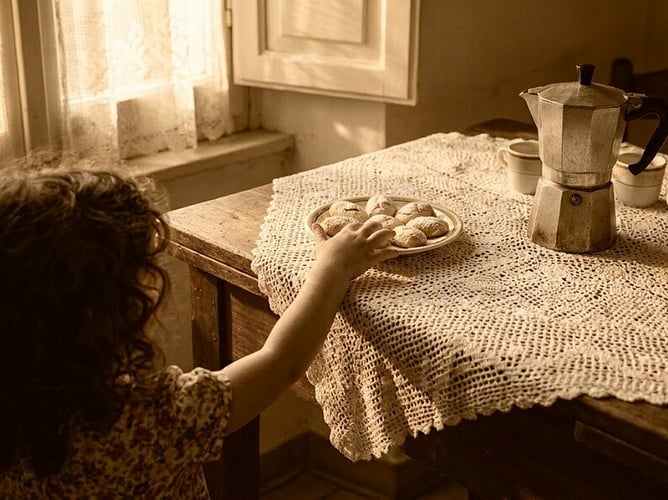
Some of my earliest memories are not of classrooms or playgrounds. They are of a kitchen table.
My Nonna lived in the centre of town in far north Queensland, in a sugar cane community where everybody knew everybody, and where reputation and loyalty meant everything. From the time I was six years old, I would sit at her kitchen table and watch the world come to her.
The table itself had a story. My great grandparents had arrived from Italy in the early 1920s, making a home in the wilds of the Daintree. A table had been fashioned by a fellow Italian wood worker for work in lieu and was pride of place in the kitchen. The story goes there was an intense cyclone bearing down and that table was tied with rope to the roof beams, holding at least some part of the house together through the storm. Whether folklore or fact, I have always loved that image. Something solid, something anchored, holding things together when everything around it was uncertain.
The table was handed down to my Nonna. On that table, my Nonna would lay a crocheted tablecloth she had made herself. A pot of tea on one side. Fresh coffee on the other. Cakes and biscuits in between. And through her door, all day long, came women.
They came with lemons from the garden. Vegetables from their property. Small offerings. But what they really came with were their stories. Their worries. The things they could not say anywhere else in a town where everyone was watching.
My Nonna would listen. Deeply and without judgement. She would sit with whatever was brought to her, take it seriously, and then she would speak. Quietly and directly.
Over the years I came to understand that she was doing something quite remarkable. She was helping these women find their way through some of the most difficult moments of their lives. Marriages in trouble. Money being gambled away. Futures that needed to be quietly, carefully rebuilt. She helped in many ways. She accompanied women to bank manager appointments. She deciphered contracts. She mediated between family members and sorted out disagreements. She held families together. She was, in every sense, a dispenser of wisdom.
She was a consigliere, a trusted adviser in the Italian tradition, and to all who came through her door, a true confidant. The keeper of secrets. Trusted completely.
I did not understand all of this at the time. I was a child at the table, grateful for the biscuits. But something was being shaped in me during those visits, something about what it means to truly listen, to hold people's stories with care, and to help them move forward without judgement.
That is the work I do today.
The details are different. The setting has changed. But the heart of it is the same. People come to me at moments when something has shifted in their lives, and they need someone who will sit with them, understand what is really happening, and help them find their way through.
I think about that table often. The one that held through the storm.
That is what I hope to be for the people I work with.